The Challenge
Building an evidence base for the long-term
Defra wanted to strengthen its evidence base around the long-term forces shaping its future operating environment — looking beyond immediate policy pressures to understand the deeper political, social, environmental, technological and economic shifts that influence the world Defra works within.
The Global Megatrends report sat within a wider programme of work alongside Horizon Scans and Emerging Trends research. While those products focussed on weak signals and emerging patterns of change, the Global Megatrends report needed to zoom out: identifying the large-scale structural forces that have shaped global systems over decades, centuries, and in some cases millennia.
A key challenge was definitional. Previous megatrend work — both within Defra and across the wider landscape of government, consulting and NGO publications — used the term inconsistently. A tighter, more defensible definition was needed before any megatrends could be selected.
Our Approach
A five-step methodology
The 2024 GMT Report was developed by applying a structured five-step methodology. Defra's 2022 GMT Report served as the starting point for analysis.
Trend Review
The process began with an analysis of the 10 megatrends outlined in Defra's 2022 GMT report, validating or challenging the extent and magnitude of their current observable global impacts. These findings were cross-referenced with a systematic meta-analysis of 24 megatrend reports produced by private organisations, governmental bodies, NGOs and think tanks. Reports were selected based on their alignment with scope, relevance, reputation and methodological rigour.
Trend Framing
Following the review, the trend framing process identified novel themes and patterns in alignment with the definition and scope of observed global megatrends. The definition criteria — global breadth, multi-system impact, long time span, clear direction of travel — remained central throughout, ensuring each trend met the threshold for classification as a GMT. This process resulted in 19 potential megatrends, subsequently shortlisted to 12.
Trend Building — First Draft
The first draft of the 12 GMTs each comprised a summary analysis cover page and four in-depth sections: origin point, overview, historical trajectory, and advancing or constraining indicators. A key methodological innovation was the development of origin points — the historically identifiable moment at which each megatrend first became visible as a sustained structural shift. This moved the report away from prediction and toward understanding the long-run forces already shaping the present.
Challenge Sessions
The completed first draft was reviewed, scrutinised and stress-tested with 44 experts from diverse backgrounds — government, academia, industry and NGOs — in structured one-hour Challenge Sessions. Each GMT was examined by five to six subject matter specialists. Sessions were designed to gather feedback, critically assess the findings, identify biases, and fill knowledge gaps. Participants received each GMT in advance and were expected to review and research it before attending. Two proposed megatrends were removed at this stage because they did not meet the evidence threshold.
Trend Synthesis — Final Draft
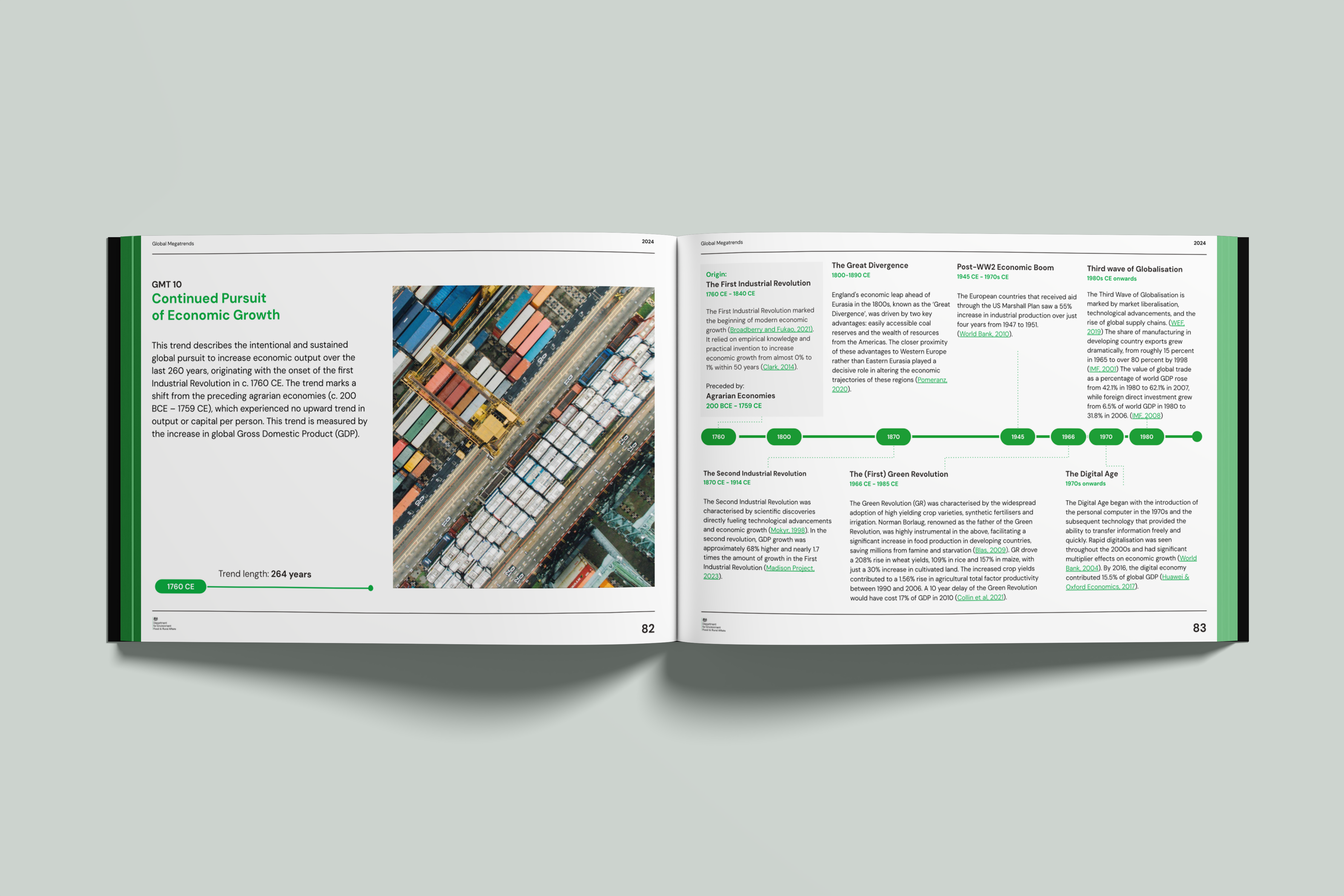
All insights and feedback from the Challenge Sessions were synthesised into the final GMT draft. The final report retained the same structural sections as the first draft, and additionally includes a GMT map illustrating the trends' overlaps and relative relationships within the PESTE framework, alongside a visual representation of each GMT's historical origin with associated confidence levels based on available evidence.
A Spotlight on Origin Points
Most megatrend reports look forward. This one also looked back.
"Rather than treating megatrends as broad themes or forecasts, we defined them as structural forces with global breadth, significant scale, and a clear direction of travel over time — and looked historically for the moment at which each shift first became visible."
The origin point methodology gave Defra a more rigorous way to distinguish between emerging trends, large-scale structural forces and short-term change. For each megatrend, we identified the historical moment at which a clear shift from one operating environment to another became visible across multiple continents, sectors or systems.
Some megatrends originated in the Industrial Revolution. Others were traced to the Agricultural Revolution or earlier. For example:
Accelerating Anthropogenic Climate Change originates in approximately 1830 CE — when industrial activity began measurably altering atmospheric chemistry after the first Industrial Revolution.
Accelerating Environmental Degradation originates in 10,000 BCE — when the Neolithic Agrarian Revolution first initiated sustained, large-scale ecosystem alteration across multiple continents.
This historical lens demonstrated that many of the forces shaping policy today are not new. Confidence levels were assigned to each origin point based on the available evidence, making the methodology transparent and open to academic scrutiny.
Results
Three outcomes for Defra
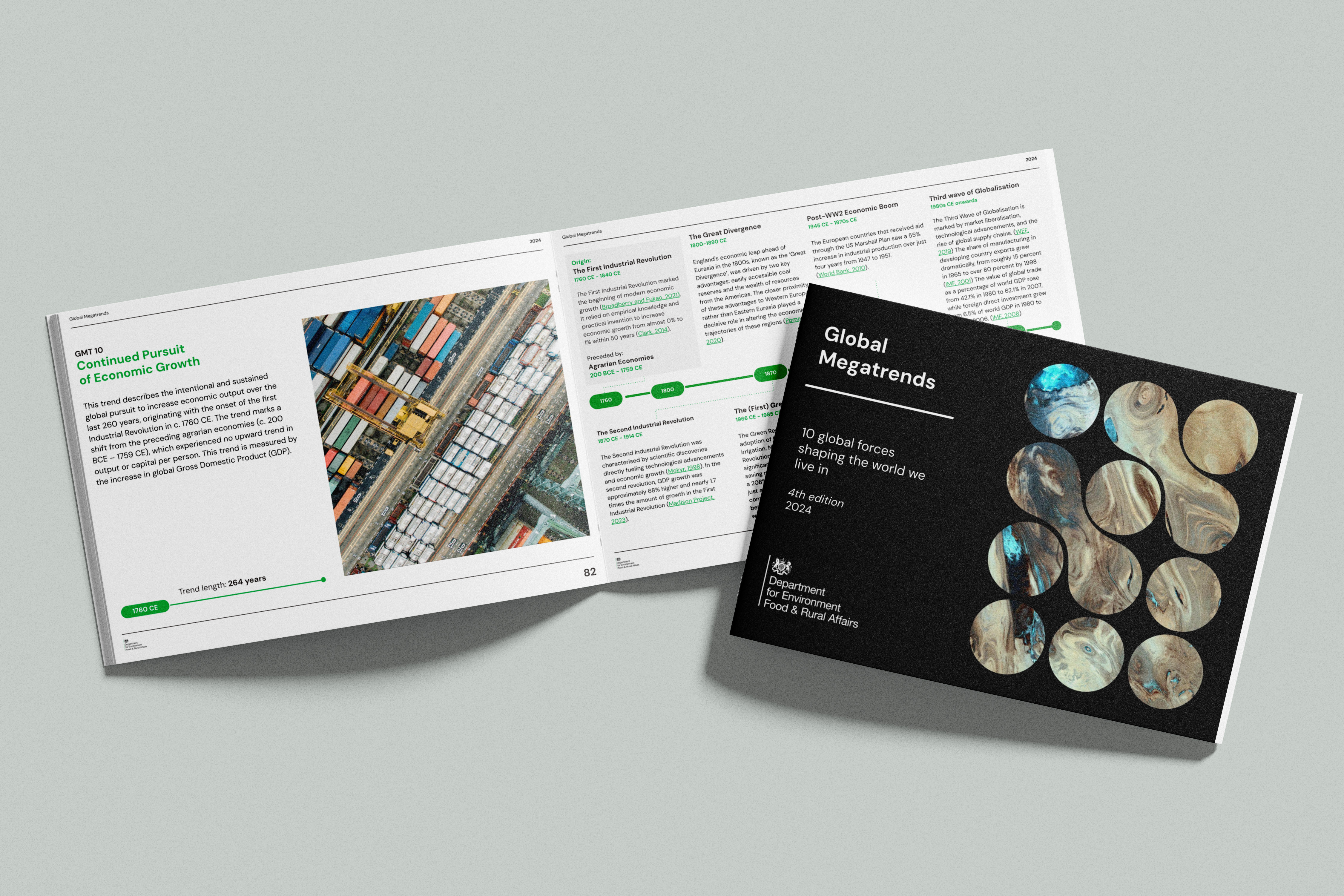
The final report identified 10 Global Megatrends shaping Defra's future operating environment. Each megatrend includes a definition, overview, timeline, origin point, indicators, and advancing or constraining factors — giving Defra a structured way to understand major global forces.
The origin point methodology gave Defra a more rigorous way to distinguish between emerging trends, structural forces and short-term change. This made the report more defensible, historically grounded and useful for strategic discussion across government.
The Global Megatrends report was one part of a wider system of futures products, alongside ongoing Horizon Scans and six-monthly Emerging Trends reports. Together, these products help Defra connect weak signals, emerging patterns and long-term global drivers of change.
About Andthen
The team behind the report
Andthen is a futures consultancy working with governments, institutions and organisations to build their capacity to think and act long-term. The Global Megatrends report was produced by Andthen in collaboration with Defra Futures.
The work spanned comparative research, methodology development, primary drafting, expert facilitation, and synthesis — drawing on Andthen's experience in horizon scanning, strategic foresight, and evidence-based futures work.