The Definition
A structural force — not a prediction
The Global Megatrends 4th Edition uses a precise, evidence-based definition to distinguish megatrends from forecasts, emerging trends, and policy priorities. Every GMT in this report was assessed against this definition before inclusion.
A structural force defining the broad nature of future operating environments. As phenomena, they present over large geographical areas (more than one continent) and over a significant period of time (at least a decade). They are transboundary; influencing multiple systems (e.g. food and healthcare) and domains (e.g. air, land, water, space, cyber). Megatrends are aggregates — they homogenise emerging trends, sacrificing nuance and variability for generalisability.
This definition emerged from a comparative analysis of 24 existing megatrend reports and was refined iteratively through the research process. Its purpose is to ensure that each GMT can be evidenced, not merely asserted.
The Three Constituent Parts
Global. Mega. Trend.
The word megatrend contains three distinct criteria. Each is necessary; none is sufficient on its own. A force that is global and large-scale but lacks a clear direction of travel is not a megatrend. Equally, a clear directional trend that is only regional in scope does not qualify.
The force must be observable across multiple continents. Regional shifts, however significant locally, do not qualify as Global Megatrends.
The force must cut across multiple systems — such as food, health, energy, and governance — and across multiple domains including land, water, cyber, and space.
There must be a demonstrable, sustained direction of travel across at least ten years. Short-term fluctuations or cyclical patterns do not constitute a megatrend.
Clarifying the Concept
What megatrends are not
The term megatrend is frequently misapplied. Across the 24 reports reviewed, the same four confusions appeared repeatedly. Naming them clearly helps to make the concept more useful in practice.
Emerging trends are early signals of possible change. Megatrends are established, evidenced structural forces. The two exist at different points on the spectrum of certainty and scale — and should be treated as separate analytical tools.
Megatrends describe forces that are already operating in the present, rooted in the past. They are not projections of what might happen. They are descriptions of what is already structurally underway.
Policy priorities are normative — they reflect what an organisation has decided to act on. Megatrends are analytical — they describe the operating environment regardless of policy preference or organisational mandate.
A challenge that is acute in one country or region may be real and significant, but it does not constitute a global megatrend unless it meets the transboundary, multi-continental threshold.
The Origin Point Methodology
Looking back to see forward
"Long-running structural forces are not new. They have origins — historically identifiable moments at which a clear shift from one operating environment to another first became visible. Finding those moments makes the analysis more rigorous and the megatrends more defensible."
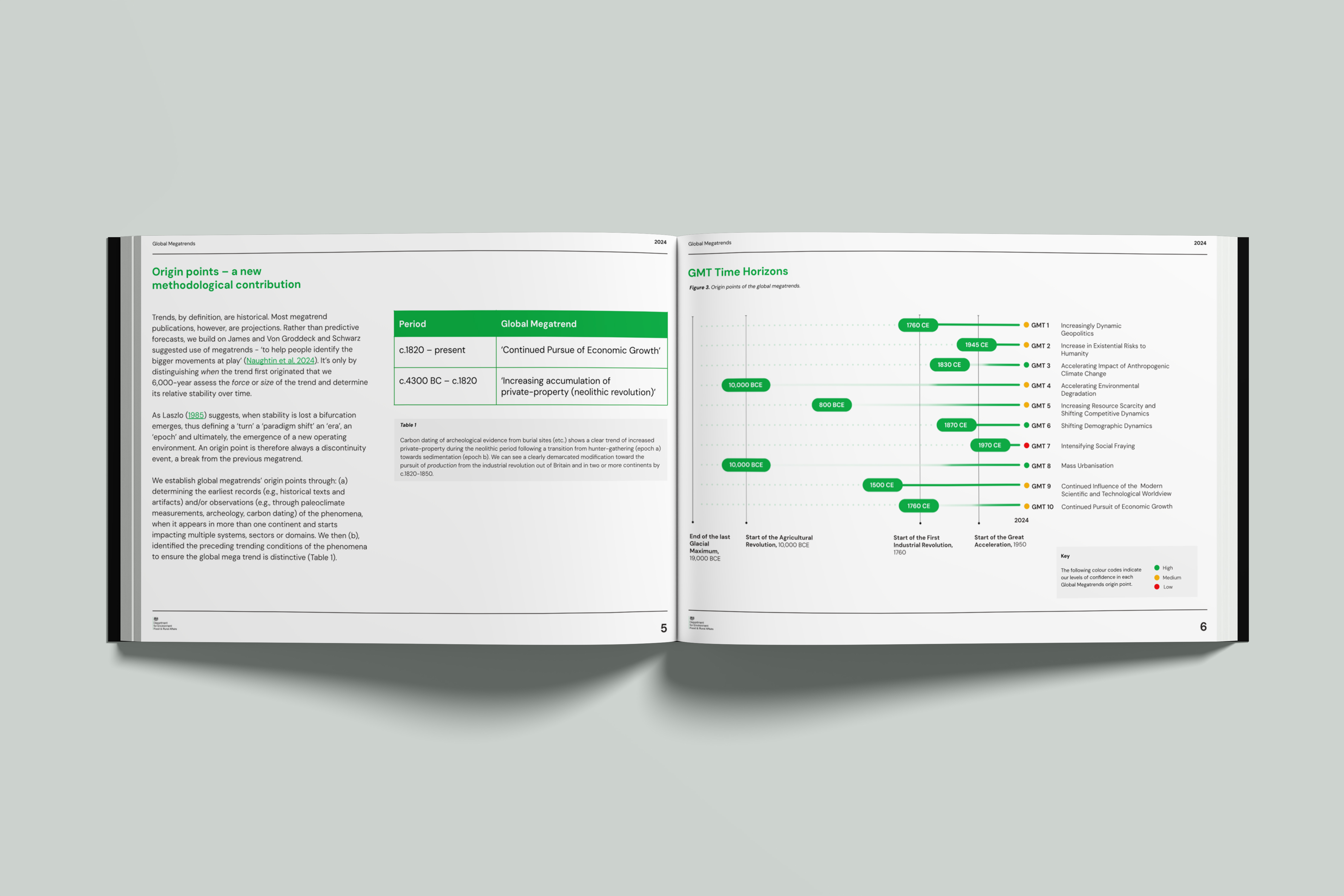
A key methodological innovation in the 4th Edition was the development of origin points — the historically identifiable moment at which each megatrend first became observable as a sustained structural shift across multiple continents, sectors or systems.
For each GMT, the research team traced back through available historical evidence to identify when a given megatrend first crossed the threshold from emerging pattern into structural force. Confidence levels were assigned to each origin point based on the quality and breadth of available evidence, making the methodology transparent and open to scrutiny.
This approach moved the report away from the typical megatrend format — which tends to assert large-scale change without grounding it historically — toward a more evidential, structural account of why these forces are already shaping the present.
Important Context
Evidence — not government policy
The Global Megatrends report was externally commissioned by Defra for research and evidence purposes. Its purpose is to strengthen Defra's long-term strategic evidence base — not to set, reflect or endorse government policy.
The 10 GMTs in this report were selected from a longlist of 19 candidates, assessed against the definition criteria and tested with 44 international experts. Two were removed after Challenge Sessions because they did not meet the evidence threshold. The final selection reflects what the evidence supports — not what is politically expedient or currently prioritised.
The report does not represent Defra's views, nor does it constitute official government policy. Readers should treat it as an analytical product — a structured account of the large-scale forces shaping the global operating environment.